The Quiet Rise of Grenadian Singer Sabrina Francis
- Mellany Paynter
- 53 minutes ago
- 5 min read


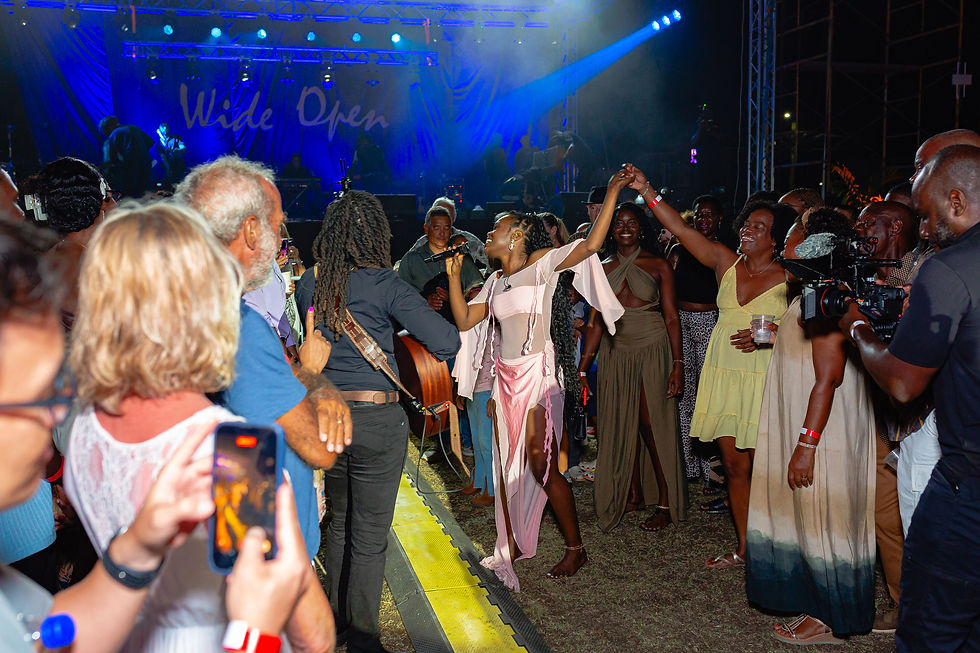
The Wide Open concert had barely started when Sabrina Francis stepped off the stage and walked straight into the crowd. No barrier, no entourage, just an artist and the thousand people she'd spent eight years earning. Someone photographed the moment: Sabrina, surrounded, her face lit with something that looked less like fame and more like relief.
"To really feel your backyard pumping for you," she said afterward, still catching her breath. "To really feel connected to your own people. That's been filling something I didn't even know I missed."
It is the kind of homecoming that takes years to build, and Sabrina has been building it, quietly and stubbornly, since she was a teenager with a desire to be like her mother.
A voice discovered by accident
Sabrina grew up in the north of Grenada, in the countryside, the daughter of Donysia Domerge, an avid Calypsonian and songwriter who goes by the stage name Lady Empress. "A powerful songwriter," Sabrina says, and credits her talent to being raised in a household was steeped in music.
But in Grenada, music as a career pathway was not considered serious. "It was always like a joke," Sabrina recalls. She pointed herself toward accounting instead. Then, at seventeen or eighteen, she was invited to sing at a Christmas gospel event. In the audience that night, the owner of a local hotel watched her perform. He didn't introduce himself, but he and his wife spent the next year searching for her, and when they finally reached her, they offered her a New Year's Eve slot to sing at the hotel.
She recalled putting together a setlist, learning the songs, and playing some originals. A band was assembled. It was 2014/2015, her first real show.
"I kept writing what my soul wanted. And I kept forcing it down Grenadians' throats. Eventually, they came around."
Texas, social media, and a new seriousness
For several years after, Sabrina and her team made music for the love of it with no strategy, and no grand plan, creating Afro-Caribbean Pop that blends genres to create a unique sound. Then in 2019, they traveled to an independent musicians' conference in Austin, Texas.
The message there was simple and electric: you can do this yourself, right now, wherever you're from. Social media has leveled the field. You don't need a label to discover you.
"That was really inspiring for us," Sabrina says. From 2019 onward, she went full-time. She sought out producers to raise the quality of her sound. She took songwriting more seriously. She began to think in terms of collaborations, strategy, career.
The Grenadian audience, however, was not immediately persuaded. In her early years, the crowds at her shows were mostly tourists. Locals didn't know what to make of her music, soulful, experimental, not quite soca, not quite jazz. There was pressure, sustained and real, to lean into soca. She resisted. "I just kept writing what my soul wanted," she says. "And I kept forcing it down Grenadians' throats."
Eventually, they came around.
A concert born in a chicken coop
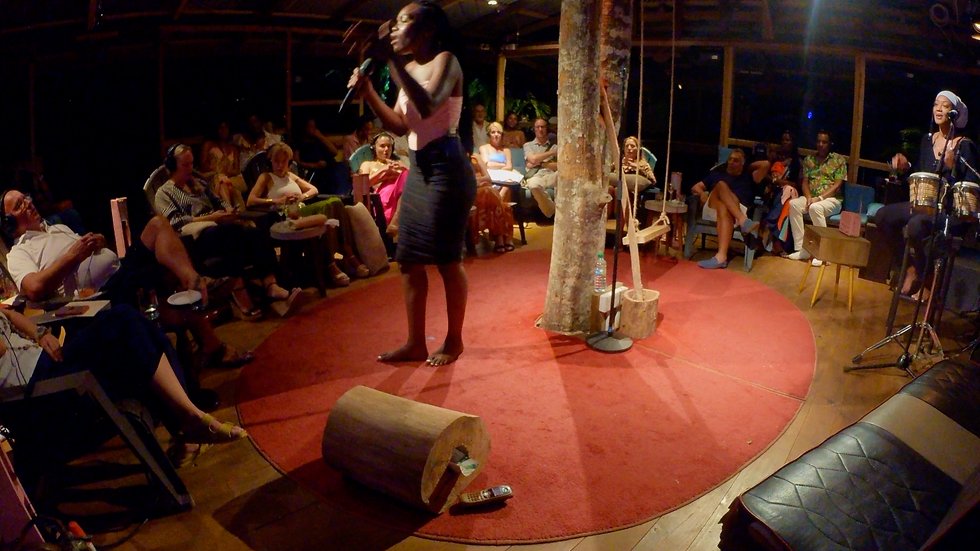
During the COVID-19 pandemic, when gatherings were capped at sixteen people, Sabrina refused to stop performing. She and her team gutted out a chicken coop behind a studio in the mountains of Mount Agnes, planted a tree in the middle of it, and began hosting intimate concerts. They called it Sabrina's Treehouse.
"The audience each gets a headphone so they can be as close to the music as possible. Then they sit around the tree. And I perform in a circle around the tree. Immersive. And then the lights go down." — Sabrina Francis, on Meet Me At the Mango Tree
What began with sixteen guests grew to twenty-five, then thirty, eventually fifty. Then Sabrina evolved it entirely. She wrote a story, a true Caribbean story about parents who leave young children behind to build better lives elsewhere, about the resentment that follows, and about, ultimately, forgiveness. She set the story to twelve original songs, collaborated with a Nigerian producer, and turned it into a theatrical one-woman show: Meet Me at the Mango Tree.
Audiences arrived via a shuttle at the foot of the mountain, walked a red carpet on arrival, received a welcome drink, socialized for an hour, then took their seats, each wearing a headphone, and were transported for eighty minutes of immersive, circular performance. The show ran for two years. It was almost always sold out.
The story, Sabrina acknowledges, is partly personal. Her mother left, too, though not for long. "It's a flourished autobiography," she says carefully, "but not full."
After performances, audience members would approach her in tears. One woman, in her forties, told Sabrina she still calls her mother by her first name, because the mother left when she was young, and never became, in her mind, a mother.
"Kids prefer presence above all," Sabrina says quietly. This was an ode to kids left behind.
A concert named for what she asks of her audience
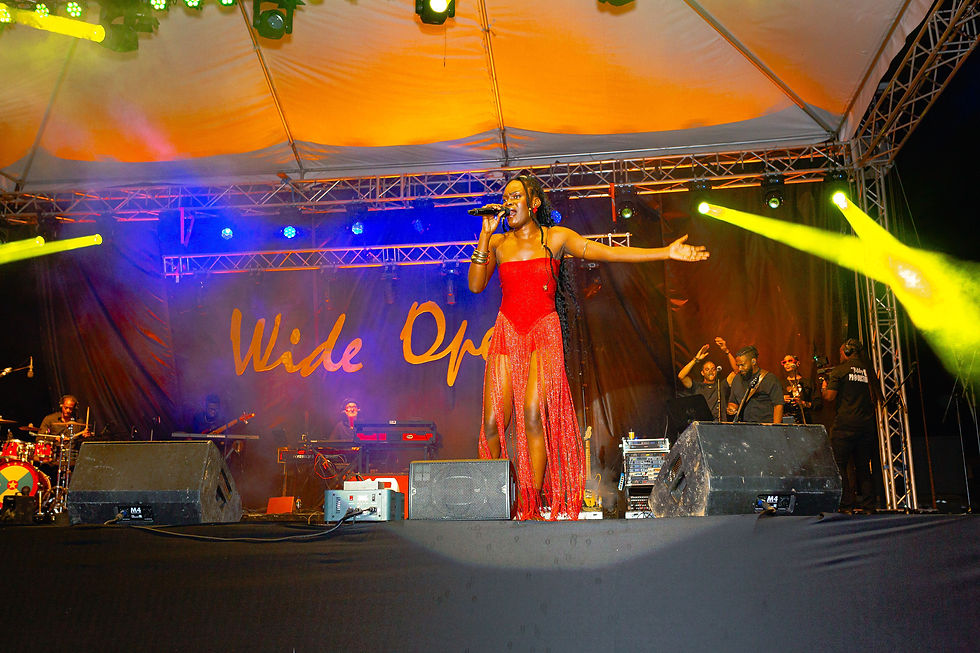
The name of Sabrina's annual flagship concert comes from one of her songs, but it also describes the invitation she's been extending to Grenadians since the beginning. Come with an open mind. Come wide open. You won't leave with what you expected, but you'll leave with something.
She started it at Le Phare Bleu with about 200 people. Each year, the numbers climbed: 300, then 400, then approaching 800 and now 1,000. This year, she mentored two young artists: Amiya Henry and Naomi Allard, who opened the show with a full 30-minute set. It was their first performance ever, in front of nearly a thousand people.
At this year's show, Sabrina also debuted a soca track “Honour You”, which she wrote for a man she loves, produced by Trinidadian producer, Stemz. "As a gift to the people" who'd stuck with her through years of experimentation.
"Because they've been so accepting of the experimental stuff, it just felt like the right time to try Soca."
She is considering releasing it this year, and it was, by all accounts, a surprise, and a welcome one.

Building inward before going outward
Sabrina's ambitions are international, which she's been very open about. But an early attempt to break into the UK market taught her something: arriving in a vast, competitive market with niche, experimental Caribbean music, without the infrastructure to support it, is not a strategy. It's expensive hope.
So for 2026, she's adjusting. She wants to go deeper into the Caribbean diaspora first. More regional collaborations, more Caribbean producers and artists, more music that speaks the language of her own people before asking the world to listen. "
I want to connect on a deeper level," she says. "Get the backyard fully on board, and then propel forward."
She is not in a hurry. She is, perhaps, finally in her moment. The woman who once performed for tourists while Grenadians looked away now looks out from her stage and sees, as she puts it, "so much more Black faces", her own people, finally leaning in. It’s a lesson in persistence, of staying true to yourself.
"I feel very strongly," she says, "that people should hear my message. And I am going full force."
Check out her latest release below.
Sabrina Francis is a Grenadian singer-songwriter and creator of what she calls Afro-Caribbean Pop: a genre-blending sound as adventurous as it is soulful. With two albums, two EPs, and a growing catalogue of singles, she has built her career on fearless experimentation and deep roots in Caribbean storytelling. She has collaborated with Grammy-nominated Nigerian producers, appeared on a Disney+ special alongside Pentatonix, and opened for Asa at London's Royal Albert Hall, making her the first Grenadian musician to perform there. At home, she is the force behind Wide Open, Grenada's premier contemporary music concert, and the immersive theatrical experience Meet Me at the Mango Tree.
Follow her @sabrinafrancismusic on all platforms.


Comments